
Maulana Azad National Institute of Technology (MANIT) is one of the leading institutions of national importance in the area of technical education, established with the objective of developing a "Centre of Excellence" in the central region. It aims at becoming a multi-disciplinary Centre for technical education by strengthening both teaching and research activities besides contributing to the needs of rural community, society and industry at large. Institute is fully funded by Ministry of Human Resource Development, Government of India and is governed as per provisions made under the National Institute of Technology, Science Education and Research Act 2007 (NITSER Act 2007).
MANIT is on the way to develop Central Research Facility aiming to create advanced research facility with more emphasis on Industry-academia interaction and to meet community needs for technology driven solutions. These state-of-the-art analytical and high-end instruments are housed at a single location manned by qualified & skilled personnel to provide scientific and technical services for supporting research carried out by UG, PG, PhD and project students and also for consultancy works. Such a facility represents a key commitment for preserving and raising the efficiency of research to top international standards. It strengthens the research-relevant infrastructure of basic science and technologyis located in New Teaching Block (NTB) It house the most modern equipments as a facility to the users of the ever-expanding number of UG, PG students & researchers with various needs coming from different fields.
- To create state of the art research facilities for promotion of interdisciplinary research in areas of Chemical Engineering, Materials Science and technology and Physics
- To make the facilities accessible to all internal, external and industry users for research and development.
- To promote active collaboration with institutes, universities, research laboratories and industries.
- To provide a platform for carrying out sophisticated experiments in the area of materials science and engineering.
The Central Research Facility envisions are to provide state of the art materials characterization systems for all students at MANIT Bhopal and other academic and industry users to carry out their research activities. It further envisions the creation and maintenance of appropriate ambiance entailing drives in research for the development of appropriate materials technology. The equipments housed in the CRF are used for various types of characterization including study of structure and chemical composition of materials at different length scales (sub-nanometre to millimetre), phase transitions, as well as evaluation of mechanical, electrical and optical properties.

Prashant V. Baredar
Coordinator, CRF
Professor, Department of Energy Science & Engineering
More Information

Dr. S. Suresh
Convenor & Faculty In-charge, CRF
Associate Professor, Department of Chemical Engineering
More Information
-
Dr. Rajesh Purohit, Professor, Mechanical Engineering Department
-
Dr. Fozia Z Haque, Associate Professor, Physics Department
-
Dr. Raman Nateriya, Assistant Professor, Mechanical Engineering Department
-
Dr. Vijay Kumar Bulasara, Associate Professor, Chemical Engineering Department
-
Dr. Amit Ojha, Associate Professor, Electrical Engineering Department
-
Dr. C. Sasi Kumar, Associate Professor, Metallurgical and Material Engineering Department
-
Dr. Khushhali M. Pandey, Associate Professor, Biological Science and Engineering
-
Dr. Bharat K. Modhera, Associate Professor, Chemical Engineering Department
-
Dr. Dharmendra Pandey, Assistant Professor, Chemical Engineering Department
-
Dr. Dharmendar Sharma, Assistant Professor, Chemistry Department
-
Dr. Piyush Kumar Patel, Assistant Professor, Physics Department
-
Dr. Jyoti Rani, Assistant Professor, Physics Department
-
Dr. Rupak Kishore, Assistant Professor, Chemical Engineering Department
-
Dr. Ram Kishore, Assistant Professor, Metallurgical and Material Engineering Department
-
Dr. Sunder Lal Pal, Associate Professor, Chemical Engineering Department
-
Dr. Sanjay Srivastava, Professor, Metallurgical and Material Engineering Department
-
Dr. Sukanti Behera, Assistant Professor, Chemistry Department
-
Dr. Arvind Kumar, Assistant Professor, Mechanical Engineering Department
-
Dr. Narendra Laxman Gajbhiye, Assistant Professor, Mechanical Engineering Department
-
Dr. Sudhanshu Kumar, Assistant Professor, Mechanical Engineering Department
-
Dr. Rutuja M. Chavan, Assistant Professor, Civil Engineering Department

Mr. Prashast Manglik
Technical Officer
Email id:- prashast[AT]manit.ac.in
Phone No:-0755-405-1006
-
Mr. Harish Vaidya, Deputy Registrar (Store & Purchase)
-
Mr. Rakesh Singh (Storekeeper)
3-AXIS ADDITIVE–SUBTRACTIVE HYBRID METAL MACHINE
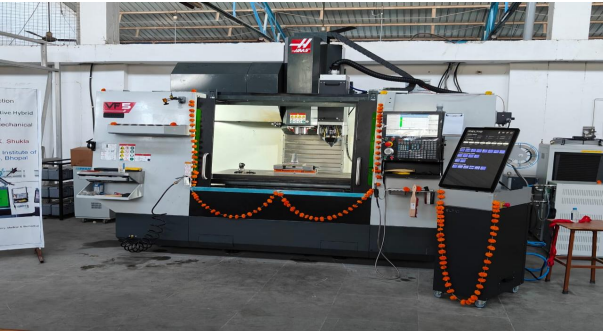
A 3-Axis Additive–Subtractive Hybrid (Dual) Metal Manufacturing Machine is an advanced manufacturing system that integrates both metal additive manufacturing and CNC subtractive machining within a single platform or dual-setup configuration under three-axis control. The system enables the fabrication of near-net-shape metal components through additive manufacturing, followed by precision machining to achieve the required dimensional accuracy and surface finish. The proposed equipment is intended to strengthen the research infrastructure of the Central Research Facility (CRF) by providing a state-of-the-art platform for advanced manufacturing, interdisciplinary research, and industry-oriented innovation. The machine will facilitate research and development in metal additive manufacturing, hybrid manufacturing, process optimization, repair and remanufacturing, and precision machining, while promoting collaboration among academia, research laboratories, and industry. This is in line with the vision and mission of the CRF to establish advanced research facilities accessible to internal users, external academic institutions, and industrial organizations.
The system will also serve as an advanced teaching and training facility for UG, PG, and Ph.D. students and research scholars, enabling hands-on learning of both additive and subtractive manufacturing technologies on a single integrated platform. Students will gain practical exposure to the complete manufacturing workflow, including component design, metal deposition, precision finishing, quality improvement, and functional part development. The facility will significantly enhance laboratory-based education, project work, research activities, skill development, consultancy, and technology transfer in the field of advanced manufacturing.
Furthermore, the availability of this hybrid manufacturing system within the CRF will support the development of high-value metal components for research, prototyping, and industrial applications, thereby contributing to the institute's objective of establishing a world-class research ecosystem and promoting industry–academia interaction. To ensure efficient utilization, transparency, and proper documentation of the facility, every user shall submit a User Requirement Form before availing the services of the 3-Axis Additive– Subtractive Hybrid (Dual) Metal Manufacturing Machine. The form will capture essential details such as user information, department/organization, project title, supervisor/principal investigator, component specifications, material requirements, manufacturing process (additive, subtractive, or hybrid), design file details, estimated machine time, post-processing requirements, testing/inspection requirements, and safety declarations. The submitted information will enable the CRF technical staff to assess the feasibility of the requested work, estimate material and machine utilization, schedule machine time, ensure compliance with operational and safety guidelines, and maintain proper records for billing, reporting, and future reference. The standardized User Requirement Form will facilitate effective planning, optimum utilization of the facility, and quality assurance while providing manufacturing services to internal users, external academic institutions, research organizations, and industrial clients.
Instrument Details:
- Additive (Make MELTIO) : 300 x 300 x 300 mm
- Subtractive (Make HASS): 800 x 500 x 500 mm
- EDM (Make PHILLIPS): 350x 450 x 300 mm
Key Features:-
Metal Processing
- Near-Net-Shape Manufacturing
- Hybrid Manufacturing Capability
- Three-Axis Motion Control
- Single Setup Manufacturing
- Research and Development Platform
- Educational and Skill Development Tool
- Industry-Oriented Facility
Applications:-
- Metal Additive Manufacturing Research
- Hybrid Additive–Subtractive Manufacturing
- Rapid Prototyping of Metal Components
- Functional Prototype Development
Faculty In-charge:
Dr. Mohammed Taufik
Email: mohammad.taufik@manit.ac.in
Inductively Coupled Plasma Mass Spectrometer (ICP-MS)
The Inductively Coupled Plasma Mass Spectrometer (ICP-MS) is used for the qualitative and quantitative determination of trace and ultra-trace elements in various sample matrices. It utilizes a high-temperature argon plasma to ionize the sample, while the mass spectrometer separates and detects ions based on their mass-to-charge (m/z) ratio. ICP-MS enables rapid multi-element analysis with excellent sensitivity, accuracy, and precision, making it one of the most powerful techniques for elemental analysis in research, environmental studies, quality control, and industrial applications.
Model Name: ICPMS - 2030
Make: Shimadzu, Japan
Key Features:
- Simultaneous multi-element analysis of more than 70 elements.
- Capable of analyzing most element from Li to U
- Ultra-trace elemental detection (ppb to ppt level).
- High sensitivity, accuracy, and precision.
- Wide dynamic concentration range.
- Rapid analysis with high sample throughput.
- Excellent reproducibility and repeatability.
- Suitable for complex sample matrices after appropriate sample preparation.
- Capable of elemental and isotopic analysis (method dependent).
Microwave Digestion System:
Key Features:
|
Parameter |
Specification |
|---|---|
|
Microwave Frequency |
2450 MHz |
|
Input Power |
220–240 V, 50 Hz |
|
Installed Power |
3200 W |
|
Microwave Control |
PID closed-loop continuous control |
|
Rotor Capacity |
16 |
|
Maximum Throughput |
Up to 160 samples/day |
|
Temperature Monitoring |
Full-vessel non-contact infrared sensing |
|
Cooling |
Twin Air rapid cooling system |
Sample Handling & Submission Guidelines:
- Samples must be clearly labelled with a unique sample identification number.
- Liquid samples should be submitted in clean polypropylene (PP), HDPE, or PTFE containers.
- Solid samples should be submitted in clean, contamination-free containers.
- Digested samples should preferably be prepared using trace metal grade reagents.
- Clearly specify the elements required for analysis.
- Mention the sample matrix and expected concentration range (if known).
- Samples containing hazardous chemicals, strong acids, or high dissolved solids should be declared at the time of submission.
- A duly completed ICP-MS Sample Analysis Request Form must accompany every sample submitted for analysis.
Advantages:
- High analytical sensitivity with excellent detection limits.
- Simultaneous determination of multiple elements in a single analysis.
- Minimal sample consumption.
- Fast and reliable analysis.
- High precision and accuracy.
- Suitable for research, industrial testing, quality control, and environmental monitoring.
Characterization charges of Inductively Coupled Plasma Mass Spectrometer (ICPMS)
|
S.N |
Name of Equipment |
MANIT Users |
Outside Users |
||||
|
|
|
(₹) |
Other Educational Institutes (₹) |
Govt. R&D Institutions/Labs (₹) |
Industry(₹) |
||
|
Non-Funded |
Funded |
||||||
|
01) |
ICPMS |
Liquid Sample |
200/- per sample |
400/- per sample |
700/- per sample |
2000/- per sample |
2500/- per sample |
|
Solid Sample |
250/- per sample |
500/- per sample |
800/- per sample |
2500/- per sample |
3000/- per sample |
||
In addition to the testing charges, GST@18.0% will be charged extra
Electrochemical Impedance Spectroscopy (EIS) with Solar Simulator

Electrochemical Impedance Spectroscopy (EIS) with Solar Simulator is an advanced characterization technique used for studying the electrochemical and photovoltaic properties of various materials, thin films, and devices. This setup is particularly useful in the field of solar cell research, corrosion science, batteries, fuel cells, and super capacitors.
The integrated Solar Simulator provides a controlled and calibrated light source (AM 1.5 G spectrums), allowing researchers to simulate real sunlight conditions while performing EIS measurements. This enables accurate evaluation of device performance under standard testing conditions.
Instrument Details:- EIS – Auto Lab
Solar simulator – ScienceTech
Key Features:-
- Wide frequency range impedance analysis.
- High-precision potentiostat/galvanostat integrated with solar simulator.
- Illumination with AM 1.5G spectrum, calibrated intensity (100 mW/cm²).
- Suitable for solid, liquid, thin film, and device-level studies.
Applications:-
- Photovoltaic devices (solar cells – perovskite, organic, dye-sensitized, silicon-based).
- Electrochemical energy storage systems (Li-ion batteries, super capacitors).
- Corrosion studies and protective coatings.
- Photo electrochemical water splitting and hydrogen production.
- Semiconductor/electrode interface characterization.
Characterization charges of EIS with solar simulator at CRF
|
EIS with solar simulator |
|||||
|---|---|---|---|---|---|
|
Name of the equipment/ Testing |
MANIT Users |
Other Educational Institutes (Rs.) |
Govt. R&D Institution /Labs (Rs.) |
Industry
(Rs.) |
|
|
Non-funded (Rs.) |
Funded (Rs.) |
||||
|
EIS with solar simulator |
Rs. 100/- Per Sample
|
Rs. 200/- Per Sample |
Rs. 500 /- Per Sample |
Rs. 1000/- Per Sample |
Rs. 2000/- Per Sample |
Confocal Raman Microscope

Instrument Model: CTR 300-S/C-x
Make: TechnoS Instruments, Jaipur India
Raman spectroscopy is a non-destructive analytical technique based on the interaction of light with matter. It measures the vibrational energy modes of molecules through the detection of Raman-scattered light, providing chemical and structural information unique to each material (Raman “fingerprint”).
Principle of Confocal Raman Microscopy
Confocal Raman Microscopy integrates Raman spectroscopy with a confocal optical microscope to enable spatially resolved chemical analysis.
- Raman spectral data provide information related to chemical composition, molecular structure, and crystallinity.
- Confocal optics restricts the sampling volume, enabling high spatial resolution in both lateral (X–Y) and axial (Z) directions.
- This combination allows chemical analysis and mapping of individual particles, discrete features, thin layers, and interfaces, typically down to sub-micron scale.
System Configuration
Raman Excitation Sources
- Lasers: 532 nm and 785 nm (for Raman characterization)
Spectrograph & Detection
- Aberration-corrected Czerny–Turner single spectrograph
- Three gratings for CTR 300
- Spectral repeatability: < 0.1 cm⁻¹
- Spectral scan linearity: < 0.5 cm⁻¹
- CCD detector with Windows-based data acquisition and processing software
Spectral Performance
- Spectrum range: 200 – 2100 nm
- Raman shift range: 50 – 5000 cm⁻¹
- Entrance slit: 10 µm – 3.0 mm
- Interfaces: RS-232C / USB
- Optical fibre length: 2 m
Optical Microscope System
Model: ST-/LV/Ti (Inverted)
- Confocal Raman optical microscope with spatial resolution < λ/2
(typically < 500 nm using 100× objective) - Objectives available: 5×, 10×, 20×, 50×, 100× (oil immersion)
- Raman probe with appropriate Raman filter sets
- Illumination: Halogen light (reflected / transmitted)
- CCD colour video camera
- Variable laser spot size up to 300 µm (WAC)
Imaging Spectrograph
|
Model |
F-number |
Focal Length (mm) |
Spectral Resolution |
Gratings |
Raman Range |
|---|---|---|---|---|---|
|
CTR 300-S/C-x |
F/4.1 |
300 |
< 0.4 cm⁻¹ / pixel |
3 |
50 – 5000 cm⁻¹ |
Applications (Indicative)
The Confocal Raman Microscope is commonly used for:
- Chemical identification using Raman fingerprinting
- Phase identification and polymorph analysis
- Micro- and nano-scale chemical mapping
- Analysis of thin films, coatings, and layered structures
- Characterization of carbon materials, polymers, ceramics, and semiconductors
- Stress/strain studies and crystallinity assessment
- Academic research, sponsored projects, and industrial consultancy
- Research in materials science, physics, chemistry, nanotechnology, and life sciences
Limitations
- Fluorescent samples may interfere with Raman signal quality
- Very dark or highly absorbing samples may cause laser heating
- Raman signal intensity depends on sample nature and laser wavelength
- Quantitative analysis is limited and generally semi-quantitative
- Samples sensitive to laser exposure require cautious optimisation
Surface contamination can affect spectral accuracy
Characterization charges of Confocal Raman Microscope at CRF
|
Confocal Raman Spectrometer |
|||
|---|---|---|---|
|
Equipment |
Internal (INR) |
Academic/Govt R&D Institutions or labs (INR) |
Industry (INR) |
| Raman Spectra |
Rs. 350/- Per Sample |
Rs. 900/- Per Sample |
Rs. 3000/- Per Sample |
| PL,Mapping, Raman Spectra |
Rs. 655/- Per Sample |
Rs. 2500/- Per Sample |
Rs. 8000/- Per Sample |
Field Emission Electron Microscope

Field Emission Scanning Electron Microscope (FESEM)
Instrument Model: CLARA
Make: TESCAN, Czech Republic
Field Emission Scanning Electron Microscopy (FESEM) is an advanced electron microscopy technique used for high-resolution imaging and surface characterization of solid materials. In FESEM, a focused beam of electrons is used instead of light to generate images, enabling detailed examination of surface topography, morphology, and microstructural features.
FESEM is also referred to as a cold cathode field emission system, as electron emission occurs due to a strong electric field rather than thermal heating.
Specifications:
- Accelerating Voltage: 0.2keV - 30keV
- Lens Configuration: Condenser Lens – 2 Stage, IML – 1 stage, Objective Lens – 1 Stage.
- Magnification: 20X – 2000KX
- Practical spatial resolution: ~1.5–2.0 nm under standard operating conditions depending on the sample quality.
- (Specified SE resolution: 0.9 nm @ 15 keV)
Basic Principle
Electron microscopy is broadly classified into Scanning Electron Microscopy (SEM) and Field Emission Scanning Electron Microscopy (FESEM). The primary difference between SEM and FESEM lies in the type of electron emitter used.
- In conventional SEM, a thermionic emitter is used, where electrons are generated by heating a filament.
- In FESEM, a field emission source is used, where electrons are emitted under a high electric potential gradient without significant heating.
In FESEM, electrons are generated using a Field Emission Gun (FEG), typically from a sharp tungsten-based emitter tip under a strong electric field (with or without mild heating). This provides high brightness, small probe size, and low energy spread, resulting in superior spatial resolution.
The focused electron beam interacts with the sample surface and generates various signals that provide information related to:
- Surface morphology and texture
- Microstructural features
- Crystalline structure and orientation
- Elemental composition (when combined with EDS)
FESEM provides high-resolution, three-dimensional-like surface images, allowing clear distinction of closely spaced particles and fine surface features.
Energy Dispersive X-ray Spectroscopy (EDS)
Energy Dispersive X-ray Spectroscopy (EDS / EDX / EDXA) is an analytical technique integrated with FESEM for qualitative and semi-quantitative elemental analysis of solid samples.
Working Principle
When the high-energy electron beam interacts with the sample, it can eject core electrons from the atoms. The resulting vacancy is filled by an electron from a higher energy shell, releasing characteristic X-rays. The energy of these X-rays is unique for each element, enabling elemental identification based on Moseley’s law.
The transitions are described using Siegbahn notation (Kα, Kβ, Lα, etc.), corresponding to electron transitions between atomic shells.
EDS Capabilities
- Elemental identification and compositional analysis
- Detector: 70 mm² Silicon Drift Detector (SDD) with Peltier cooling
- Element detection range: Be (Z=4) to Am (Z=95)
- Data correction method: e ZAF correction

● Energy dispersive spectroscopy (EDS) detector is attached to the system to find out the composition of the samples which uses eZAF correction.
● Element detection range of EDS varies from Be (4) - Am (95) with 70mm2 SDD window with peltier cooling.
Instrument Model: Elite Super
Manufacturer: EDAX, Ametek USA
Sample Preparation Guidelines
Users are required to ensure that samples meet the following conditions prior to submission:
- Dispersion media for nanoparticles (if required): Ethanol / Methanol / Water / Isopropyl Alcohol
- Dispersion Shall be carried out using ultrasonication by the user
- Clearly mark the region of interest for cross-sectional analysis
- Sample base must be flat for proper mounting
- Samples shall be mirror polished (preferably) and etched with the suitable reagent for the microstructure.
- Biological samples must be pre-fixed using suitable fixatives
- Samples must be completely dry; hydrated samples should be dried properly
- All preparatory steps such as:
- Cutting for cross-section
- Freeze fracturing
- Fixation and staining (biological samples)
- Oven drying
must be carried out by the user
- Samples must withstand high vacuum (~10⁻⁵ Pa)
- Wet or volatile samples cannot be analysed
- Acceptable maximum sample dimensions:
- Diameter: ~12.5 mm
- Height: ~80 mm
- No loose / free / powdery particles present on surface
- Mounting Stability: Sample shall be firmly mounted on stub (carbon tape / adhesive used)
- Magnetic Materials: If magnetic, it shall be stabilized and secured properly
- Temperature Stability: Sample should not decompose under vacuum and the sample should not deform/decompose/degass after exposure to electron beam.
- Cleanliness: No dust, fibers, or external contamination on sample/stub
- Sample handling: Do not handle or carry samples with bare hands (e.g., in pockets/bags). Always carry samples in a vacuum desiccator. Users are advised to store samples in a vacuum desiccator with silica gel for an adequate duration (typically up to 24 hours) prior to characterization.
- Users are advised to bring a fresh CD/DVD or storage device exclusively for FESEM data.
Limitations
- Liquid, wet, or highly volatile samples are not permitted
- Samples that may outgas, melt, or decompose under high vacuum conditions cannot be analysed
- Non-conductive samples may require surface coating
- EDS provides qualitative and semi-quantitative elemental analysis only
- EDS has limited energy resolution (~125–135 eV)
- EDS has limited energy resolution; therefore, overlapping characteristic X-ray peaks of certain elements may not be fully resolved. In such cases, peak deconvolution and correction are limited, and elemental identification may be ambiguous.
Applications (Indicative)
The FESEM with EDS facility is commonly used for:
- Surface morphology and microstructural analysis of materials
- Characterization of nanomaterials, thin films, and coatings
- Elemental analysis of metals, ceramics, polymers, and composites
- Failure analysis and defect investigation
- Study of grain boundaries, particle size, and surface roughness
- Academic research, sponsored projects, and industrial consultancy
- Materials research in physics, chemistry, materials science, nanotechnology, and engineering disciplines
Characterization charges of Field Emission Electron Microscope (FESEM) at CRF
|
Field Emission Electron Microscope(FESEM) |
|||
|---|---|---|---|
| Equipment |
Internal (INR) |
Academic/Govt R&D Institutions or labs (INR) |
Industry (INR) |
|
FESEM (including C/Au+Pd coating) |
Rs. 520 /- Per Sample
|
Rs. 1300/- Per Sample |
Rs. 4800/- Per Sample |
| FESEM + EDS (including C/Au+Pd coating) |
Rs. 850 /- Per Sample |
Rs. 2000/- Per Sample |
Rs. 6000 /- Per Sample |
BET Surface Area Analyzer

Instrument Model: BELSORP-MINI X (BELSORP Series)
Manufacturer: Microtrac BEL Corp., Japan
The Brunauer–Emmett–Teller (BET) Surface Area Analyzer is a non-destructive analytical instrument used for the determination of specific surface area and pore characteristics of solid porous materials. The technique is based on BET theory, which explains the physical adsorption of gas molecules on a solid surface. BET theory is an extension of the Langmuir adsorption model from monolayer to multilayer adsorption.
In this method, an inert gas (typically nitrogen) is allowed to adsorb on the surface and within the pores of a solid sample under controlled temperature and pressure conditions. The adsorption occurs due to van der Waals interactions between gas molecules and the sample surface. The quantity of gas adsorbed is dependent on the exposed surface area, gas pressure, temperature, and the interaction strength between the gas and the solid surface. The adsorption data are used to calculate the specific surface area and pores characteristics of the material.
The instrument supports the measurement of adsorption–desorption isotherms, specific surface area (BET and Langmuir methods), pore size, pore size distribution, and total pore volume.
Technical Capabilities
· BET specific surface area measurement from 0.01 m²/g and above (using N₂ adsorption)
· Reliable pore size analysis for mesopores (2–50 nm) and partial microporosity (~0.7–2 nm)
· Simultaneous measurement of up to 3 samples
· Degassing facility for up to 6 samples simultaneously
· Degassing temperature range: Room Temperature to 350 °C
Sample requirement for BET
1. Only dry powder or granules, Free-flowing, non-sticky material are permitted.
2. Thin films may be analysed only after prior consultation
3. Minimum sample quantity: 100 mg
o Users are advised to carry sufficient sample for proper analysis.
o Users are advised to clearly specify the degassing temperature and time duration as per the sample in the testing form.
Limitations
1. Liquid samples are not permitted.
2. Samples should not melt, decompose, or deteriorate at the operating temperatures used during degassing or measurement.
3. The current BET system operates with N₂ adsorption only.
4. Pore size analysis is reliably applicable to mesoporous materials and partially microporous materials as specified above.Characterization charges of BET Surface Area Analyzer at CRF
|
BET Surface Area Analyzer |
|||
|---|---|---|---|
| Equipment |
Internal (INR) |
Academic/Govt R&D Institutions or labs (INR) |
Industry (INR) |
|
BET Surface Area |
Rs. 490/- Per Sample |
Rs. 1100 /- Per Sample |
Rs. 2800/- Per Sample |
| Chemisorption (per sample per analysis) |
Rs. 470/- Per Sample |
Rs. 1100/- Per Sample |
Rs. 3100/- Per Sample |
es to be shortened significantly & up-to 6 samples can be degassed simultaneously at temperature from Rt to 400 Deg C.
Gas Chromatography/ Mass Spectrometry (GCMS/MS)

Instrument Model: GCMS-TQ8050 NX
Make: Shimadzu
Gas Chromatography–Mass Spectrometry (GC-MS/MS) is an analytical technique that combines the separation capability of gas chromatography (GC) with the identification and quantification capability of tandem mass spectrometry (MS/MS). The technique is widely used for the analysis of volatile and semi-volatile organic compounds present in complex mixtures.
In GC-MS/MS, components of a sample are first separated in the gas chromatograph based on their volatility and interaction with the stationary phase of the column. The separated compounds are then introduced into the mass spectrometer, where they are ionized, fragmented, and detected based on their mass-to-charge (m/z) ratios. Tandem mass spectrometry improves selectivity and sensitivity, enabling trace-level detection and confirmation of compounds.
GC-MS/MS allows reliable identification of unknown compounds and detection of very small quantities of analytes.
Instrument Capabilities
- Identification and confirmation of volatile and thermally stable organic compounds
- High sensitivity and selectivity using tandem mass spectrometry (MS/MS)
- Suitable for trace-level analysis
- Qualitative and quantitative analysis of complex mixtures
|
Sample Preparation Guidelines Users are required to ensure proper sample preparation prior to submission:
Derivatization (If Required for Semi-Volatile Samples) Some semi-volatile compounds may exhibit poor volatility, thermal instability, or strong polarity, which can result in poor peak shape, low sensitivity, or non-elution in GC-MS analysis. In such cases, chemical derivatization may be required to improve volatility and chromatographic behaviour.
Instructions for GC-MS/MS Users
Limitations
Applications (Indicative) GC-MS/MS is commonly used for:
|
Characterization charges of GCMS/MS at CRF
|
GCMS/MS |
|||
|---|---|---|---|
| Equipment |
Internal (INR) |
Academic/Govt R&D Institutions or labs (INR) |
Industry (INR) |
|
GC-MS (Liquid Sample) |
Rs.475/- Per Sample |
Rs. 2300/- Per Sample |
Rs. 5800/- Per Sample |
Note: In addition to the above charges, GST @ 18% will be charged extra.
Contact Person: Mr. Prashast Manglik
Technical Officer, CRF
Email Id: prashast@manit.ac.in
Office Tel: +91- 755-4051006
Latest approved rates & guidelines
USER REQUIREMENT FORM: 3-AXIS ADDITIVE–SUBTRACTIVE HYBRID METAL MACHINE
Notice related to CRF testing fee payment
Sample Testing Form (Confocal Raman Spectrometer facility request form)
Sample Testing Form (Instrument: Field Emission Electron Microscope)
Sample Testing Form (Instrument: BET Surface Area Analyzer)
Sample Testing Form (Gas Chromatography Mass Spectrometer (GC- MS))
Sample Testing Form (Inductively Coupled Plasma Mass Spectrometer (ICPMS) )
Payment, Taxation, and Dispatch Terms
- Slot booking through I-STEM: CRF is onboarded on the Indian Science, Technology and Engineering facilities Map (I-STEM) portal (www.istem.gov.in). Slot booking for all users, internal as well as external, shall be made through the I-STEM portal. I-STEM is used only for booking; payment is not made through the portal.
- Slot confirmation process:
- Register on the I-STEM portal, search the equipment, select the correct user category and submit the booking request. A unique 10-digit Facility Booking Record (FBR) number is generated and shared by e-mail and SMS.
- Make the payment as per the details given in the requisition/testing form, strictly by NEFT/RTGS/UPI. Demand draft is not accepted.
- E-mail the soft copy of the duly filled requisition/testing form, proof of payment and the other documents specified in the Testing/Booking Guidelines, mentioning the FBR number, to office.crf@manit.ac.in for confirmation of the slot.
- Booking on I-STEM alone does not confirm the slot. The slot is confirmed by CRF after verification of the documents and the payment.
- The hard copy of the documents shall either be sent along with the samples or brought in person to the lab at the time of testing.
- Goods and Services Tax (GST) at the applicable rate @18% (w.e.f. 1st July 2017) shall be levied on all services, as per prevailing Government of India norms.
- The dispatch address, wherever applicable, shall be the same as mentioned on the official letterhead submitted by the user.
- GST is applicable to all users, including internal and external users, and shall be calculated as per the current applicable rate.
- All samples must be accompanied by proof of payment in order to be considered for booking/analysis. The I-STEM FBR number shall be mentioned on the proof of payment and on all documents.
- All payments shall be made in favour of “ICSC, MANIT Bhopal”. I-STEM is used only for slot booking; no payment is to be made through the I-STEM portal. Payment shall be made as per the details given in the requisition/testing form.
- The total payable amount shall be rounded off to the nearest rupee (integer value) in accordance with standard accounting practices.
- If the total amount (including taxes) is ₹0.50 or above, it shall be rounded up to the next rupee.
- If the total amount is below ₹0.50, it shall be rounded down to the lower rupee.
- Example:
- ₹169.67 → ₹170
- ₹169.47 → ₹169
- Submission/dispatch of samples: Samples shall be submitted at CRF (internal users) or sent to CRF (external users; address as given in the Testing/Booking Guidelines) only after prior discussion with the facility in-charge and confirmation of the slot. The envelope shall be marked with the FBR number, the equipment name and “Samples for ________ characterization”, and shall contain the hard copy of the documents and proof of payment.
- Test/analysis results shall be provided as follows:
- External users: Results shall be provided in soft copy through the registered e-mail ID of the user.
- Internal users: Results may be collected from the CRF office in soft copy using a user-provided writable CD/DVD
- Results shall not be dispatched through post/courier
- For any official queries or correspondence, users may contact:
Email: office.crf@manit.ac.in, prashast@manit.ac.in
Office Contact: 0755-4051006, 7983384018 - For issues related to the I-STEM portal (registration, login, booking), users may raise a ticket on the I-STEM support (Freshdesk) system or call the toll-free number 1800 425 3281.
These guidelines are issued to facilitate smooth functioning of testing and measurement activities at CRF. They are indicative in nature and subject to institutional rules, availability of resources, and administrative directions issued from time to time.
Proposed guidelines:
a) The Central Research Facility (CRF) functions as a common infrastructure facility and provides facilitation to the academic & research fraternity within the institute as well outside the institute i.e. Industries/ Research/ Academic organizations.
b) The role of CRF staff is limited to facilitating access to equipments and ensuring safe operation & basic maintenance.
c) Instrument booking & scheduling:
All users (internal and external) shall register on the I-STEM portal (www.istem.gov.in) and book their slot through the portal by selecting the equipment and the correct user category. A unique 10-digit Facility Booking Record (FBR) number is generated for each booking. I-STEM is used only for slot booking; payment is not made through the portal and shall be made as per the details given in the requisition/testing form. The booking is confirmed by CRF only after the soft copy of the documents is received by e-mail along with the proof of payment. The requirements are as follows:
For Internal Users:
1) User shall submit the duly filled CRF testing form equipment wise respectively as per his/her testing requirement along with the fee receipt and the I-STEM FBR number at the time of booking for availing CRF facilities & scheduling shall be carried out based on instrument availability, operational feasibility, and ongoing institutional requirements.
2) Payment of applicable charges, as notified by the institute from time to time, shall be made in advance. Confirmation of slot booking is subject to submission of testing form along with the fee receipt. Soft copy of documents shall be e-mailed in advance to office.crf@manit.ac.in for slot confirmation, and hard copies shall be submitted at CRF at the time of testing.
For External users:
1) User shall submit the requesting letter addressed to “The Coordinator, CRF, and MANIT Bhopal” duly sealed and signed by his/her supervisor & HOD/HOC on the letter head, testing form respective to the usage of the equipment (duly filled with seal & sign), fee receipt & ID-card issued by the institute/organization.
2) Payment of applicable charges, as notified by the institute on CRF website from time to time, shall be made in advance. Confirmation of slot booking is subject to submission of testing form along with the fee receipt. Soft copy of documents shall be e-mailed in advance to office.crf@manit.ac.in, mentioning the I-STEM FBR number, for slot confirmation & hard copies of documents shall either be brought at the time of testing or sent by post/courier along with the samples.
3) Kindly mention on the envelope i.e. Samples for _____________Testing/characterisation on “equipment name” and the FBR number if samples are sent via speed post/courier along with the prescribed documents. External users may also visit the CRF in person for the testing.
4) Any wrong information quoted may lead to cancellation of your booking.
5) The equipment requisition/testing form can be downloaded from the website of the institute.
6) Kindly do not dispatch the samples without prior discussion with the facility in-charge/operational expert and contact the facility in-charge before sending the samples for characterization. Samples shall be dispatched only after the slot is confirmed by CRF.
7) Mode of the payment: The payment should be made in advance as under: The mode of the payment is strictly by online transfer through NEFT/RTGS/UPI. Demand draft is no longer accepted. I-STEM is used only for slot booking; no payment is to be made through the I-STEM portal. Payment shall be made as per the details given in the requisition/testing form. The details of the account are as under:
|
Name of the Account holder |
MANIT, ICSC Bhopal |
|
Name of the Bank |
SBI, MANIT Campus Bhopal |
|
Account No |
10020150016 |
|
IFSC Code |
SBIN0001608 |
|
MICR Code |
462002014 |
|
GST Number |
23AAATD5152E1Z9 |
8) Postal Address: The Coordinator,
Office of the Central Research Facility (TA-115) NTB,
Maulana Azad National Institute of Technology, Bhopal - 462003
9) On the top of the envelope, also mention "Samples for _______characterization.”
d) Users are requested to collect their samples immediately after testing. CRF shall not be held responsible for any loss, damage or deterioration of samples if not collected immediately after the experiment.
e) Users are solely responsible for sample preparation. Basic sample preparation guidance can be taken from CRF staff as per the requirement of the equipment for testing. Details of the basic safety related measures & sample preparation is also available on CRF website in the list of facilities section.
f) CRF shall not be obligated to repeat any characterization under a single payment. Re-measurement will be carried out only if the instrument malfunctions or develops technical issues, as confirmed by CRF staff.
g) The user must be physically present during the experiment.
h) Food, beverages, and eatables are strictly prohibited inside CRF lab.
i) Users are responsible for: Immediate collection of data after completion of measurements, Safe backup and long-term storage of their data.
j) CRF will not be liable for: Data loss after completion of measurements, Data interpretation, Errors arising from incorrect sample information or preparation.
k) All measurement data stored on CRF systems will be deleted after three (03) months from the
date of measurement.
l) For FESEM characterization, a single booking slot shall accommodate either three samples or a total testing duration of two hours, whichever occurs first. Users are requested to discuss testing requirements with CRF personnel prior to making bookings and payments.
m) Rescheduling is allowed only with valid and justified reasons, subject to approval by the competent authority.
n) Payment made for one characterisation technique cannot be adjusted against another technique or equipment.
Acknowledgement and Publications
Users may acknowledge CRF MANIT Bhopal in: Journal publications, Conference presentations, Theses and reports
Suggested acknowledgement: “The authors acknowledge the Central Research Facility (CRF), MANIT Bhopal, for providing the measurement facilities.” (One can mention here the specific name of the equipment also)
Contact Information
For queries related to testing, please contact:
Technical Officer / Operational expert CRF, MANIT Bhopal for the respective equipment on office.crf@manit.ac.in, prashast@manit.ac.in
Telephone: 07554051006, 7983384018


